

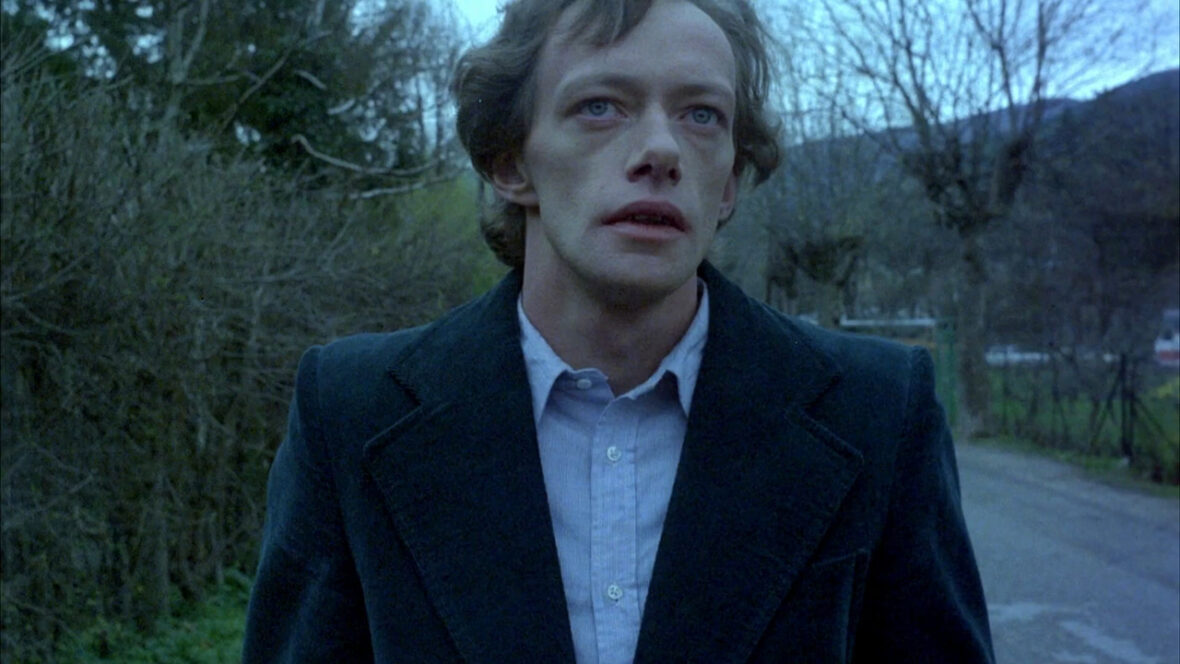
I’m not entirely sure how I discovered Gerard Kargl’s feverish, controversial feature debut, Angst. Unlike other arthouse serial killer movies like Henry: Portrait of a Serial Killer or experimental horror films like Begotten, I didn’t stumble across a still of it on Tumblr or find it on a listicle of the most disturbing movies of all time. What I do remember, though, is the sensation of a layer of film on my skin, an urgent need to shower, and something that reminded me of the nausea and exhilaration you feel after getting off a janky carnival ride. Hours later, I realized that this must have been what the film’s nameless killer (Erwin Leder) felt as he plunged a kitchen knife into his young victim’s chest over and over again, blood spraying on the walls and into his mouth.
This isn’t the kind of film you’d watch on a date, unless you were the couple who sat in front of me during a recent screening of Angst at Low Cinema, John Wilson’s single-screen 42-seat movie theater in Ridgewood, Queens. It’s also not the kind of film you’d watch while sharing what looked like an entire rotisserie chicken, which is also something this couple decided to do. Then again, this isn’t the kind of movie that you can tell coworkers you casually went to see by yourself over the weekend without inviting a few questions, the first, and most stressful, being: what is Angst even about?
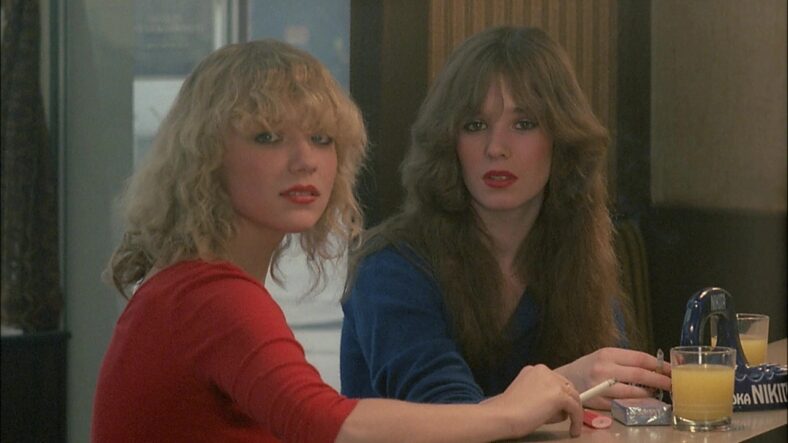
Angst is, at its core, a home invasion film that follows a killer (loosely based on Werner Kniesek) as he wanders through the Austrian suburbs shortly after his release from prison. He breaks into an isolated house deep in the woods, where he traps, tortures, and kills the entire family– an elderly mother (Edith Rosset), her daughter (Karin Springer), and her disabled son (Rudolf Götz)–one by one before stuffing their bodies in the back of their car and driving it to a cafe, intent on scaring his next batch of victims to death.
But it would be wrong to say that this is just a home invasion film. It’s a serial killer movie that reveals just how lame and incompetent serial killers actually are. It’s a nauseating, surrealist film that inspired Irréversible and In a Violent Nature. It’s a pitch-black comedy. And after my most recent watch, I’d argue it’s one of the most disturbing vampire movies that isn’t a vampire movie at all. Watching the killer exit the tunnel under the family’s home in his outdated clothes, his eyes straining against the relentlessly bright morning light, his chest and strange, almost beautiful face covered in the blood he frantically drank and vomited, I immediately thought about Udo Kier writhing on the bathroom floor in Blood for Dracula (“The blood of these whores is killing me!”) as well as German serial killer Peter Kürten, “The Vampire of Düsseldorf,” who achieved sexual gratification through his crimes.
This brings me to the psychological aspect of the film. I completely forgot going into this screening that the first act is essentially a prologue delivered to us by a narrator who seems to know a lot about the killer’s life and crimes. After we watch him shoot and kill an elderly woman at random one morning, the narrator explains that he returned to the scene of the crime, where he was arrested.
“He can barely remember the murder,” the narrator explains. “He has no motive.” The narrator describes the killer’s childhood as he’s passed off from his mother to his religious grandmother and abused by his stepfather. When he is 14, he is sexually assaulted by a much older woman who introduces him to BDSM. The camera slowly zooms in on a photo of the killer as a young boy in a knit sweater. “He feels desire to torture his mother and other women like this. But first, he captures animals.”
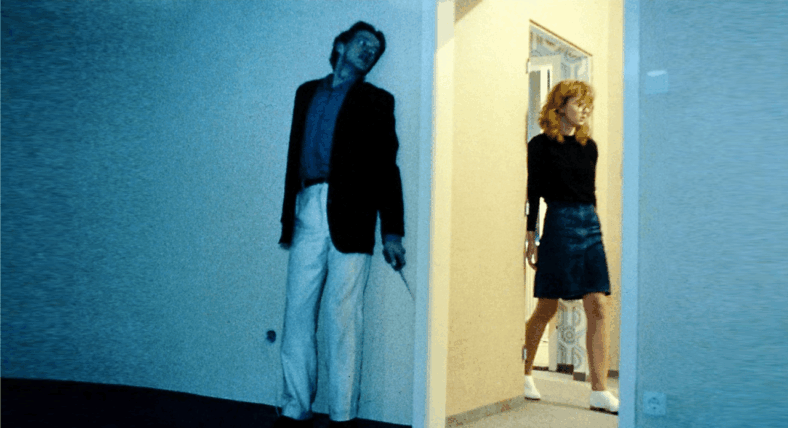
The title card flashes on screen and we are dropped into the present day, and from the moment he leaves his cell to the moment he returns to the cafe with a car full of bodies, we are firmly in the killer’s POV. He recounts his childhood from his own perspective (“The fear in her eyes and the knife in her chest. That is the last memory of my mother.”). He reveals he’s afraid of the dark. He tells us he has “special” plans for the daughter, but he admits that he has “lost control.” Nothing is going the way he wants. And yet everything is still somehow working out.
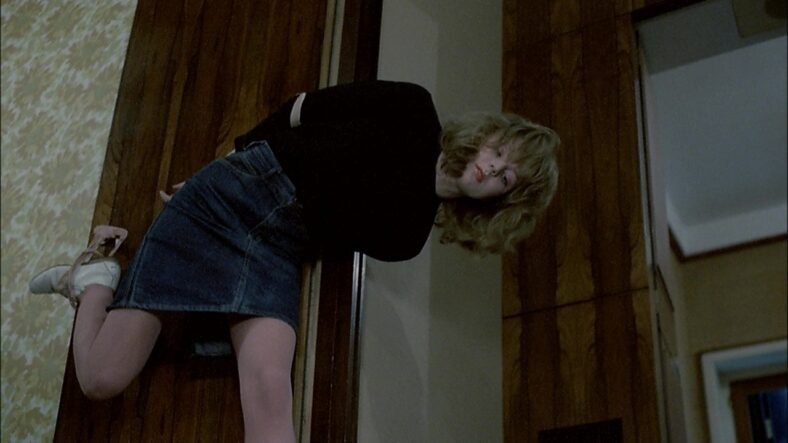
It’s these kinds of interesting choices that make Angst feel so fresh despite being over 40 years old. Almost all the characters break the fourth wall except for the killer. None of the victims show any real terror of urgency to escape. The camera seems to have a mind of its own, swiveling around the killer as he runs around the spatially impossible house, which is empty except for a single mattress on the floor and a white tuxedo hanging in the living room. Sometimes it hovers overhead like a ghost. Other times it’s extremely low to the ground, trailing alongside the killer’s ankles like the family’s adorable dachshund. There are several long, uncomfortable close ups (I keep thinking of the mother caked in the palest foundation shade I’ve ever seen on a human being, her toothless mouth a gaping black hole in the middle of her face). All of these choices make Angst one of the most realistic depictions of a serial killer I’ve ever seen on film despite nothing feeling real at all.
I wasn’t surprised when the lights came on that nobody in the theater seemed to have had a good time. Perhaps it was their first watch. The trio of girls sitting behind me shimmied into their coats and awkwardly laughed about what exactly they had just watched. The couple in front of me stuffed their trash into a plastic shopping bag and exited quietly. Almost everyone needed to use the bathroom. I watched strangers avoid eye contact as they filed into the tiny lobby, their expressions sitting somewhere in between confusion and exhaustion. I stood behind two friends who didn’t say anything to each other until one of them–a small girl dressed entirely in black–said she’d just wait outside.
I realized that this is why seeing Angst in a theater is a necessary part of the overall experience. Perhaps I’m just a masochist, but I enjoy feeling nasty and uncomfortable, and I’m happy that there’s a movie theater in my city that is devoted to screening wacky, barely-seen cult movies like Angst (at the time of writing this, Low Cinema announced a Nu Metal Cinema series running April 4th-10th featuring gems like Bride of Chucky, The Blair Witch Project 2: Book of Shadows, and Queen of the Damned). But if you’re not in New York, you can watch it now on Tubi. Play it for some unsuspecting friends and be sure to let me know your experience: @ashjenexi on Instagram and X.
https://ift.tt/SngljUw https://ift.tt/9P1Aam7
No comments:
Post a Comment